Unlock Japan’s Countryside: Driving with Your German License
If you want to leave Japan’s crowded Golden Route behind and explore hidden valleys, coastal roads, quiet mountain villages, and scenic countryside, renting a car gives you the freedom to travel at your own pace.
But can you drive in Japan with a German driver’s license?
Yes — but your German driver’s license alone is not enough.
To legally drive in Japan with a German license, you must carry:
- Your valid original German driver’s license (Führerschein)
- An authorized Japanese translation of your German driver’s license
This is especially important for German travelers because an International Driving Permit (Internationaler Führerschein) issued in Germany is not recognized for driving in Japan.
Before traveling, always check the latest requirements with the Japan National Police Agency (NPA), the Japan Automobile Federation (JAF), ADAC, or the German Federal Foreign Office (Auswärtiges Amt).
What German Drivers Need to Drive in Japan
Germany is one of the countries whose domestic driver’s licenses can be used in Japan when accompanied by an authorized Japanese translation.
When driving, you must carry both documents together.
1. Your Original German Driver’s License
Your German license must be valid.
A copy or photograph of your license is not a substitute for the original document.
2. An Authorized Japanese Translation
You must also carry an authorized Japanese translation of your German driver’s license.
The Japan Automobile Federation (JAF) is one organization authorized to issue these translations.
Translations issued by other organizations officially recognized under Japanese law may also be accepted. For German licenses, translations issued by ADAC are also recognized.
Always make sure your translation has been issued by an organization authorized for this purpose.
Important: A German International Driving Permit Is Not Valid in Japan
This is one of the most important things German travelers should know before renting a car in Japan.
Do not assume that obtaining an International Driving Permit in Germany will allow you to drive in Japan.
An International Driving Permit issued in Germany is not recognized as a valid driving document in Japan.
Instead, German travelers should use:
Valid German driver’s license + authorized Japanese translation
This requirement is also explained in the official travel information provided by the German Federal Foreign Office (Auswärtiges Amt) and in ADAC’s information for driving in Japan.
This is different from travelers from certain countries who may be able to drive in Japan using an International Driving Permit issued under the 1949 Geneva Convention.
If you are traveling from Germany, do not assume that an “international driving license” is sufficient.
How Long Can You Drive in Japan?
The period during which you can legally drive in Japan with a German driver’s license and an authorized Japanese translation is limited.
In general, you may drive until the earlier of:
- One year from your date of entry into Japan, or
- The expiration date of your German driver’s license
Special rules can apply when leaving and re-entering Japan, particularly for people who are registered as residents in Japan.
For most short-term tourists from Germany, the key point is simple:
Your date of entry into Japan matters.
For the latest legal requirements, check the Japan National Police Agency (NPA).
Keep Your Passport Accessible
Because your legal driving period can depend on your date of entry into Japan, you may need to demonstrate when you entered the country.
Keep your passport and driving documents safely accessible during your trip.
If you use automated immigration procedures at the airport, make sure that you can demonstrate your date of entry if required.
Rental-car companies may also have their own procedures for checking your documents when you collect the vehicle.
Renting a Car in Japan with a German License
When collecting your rental car, be prepared to present the documents required by the rental company.
German travelers should generally be prepared to show:
- Passport
- Original valid German driver’s license
- Authorized Japanese translation of the German driver’s license
- Rental reservation information
Individual rental-car companies may have additional requirements or document-verification procedures.
Always check the requirements of your chosen rental-car company before your trip.
A document that is legally valid for driving does not automatically guarantee that every rental company will accept a booking under every circumstance.
Left-Hand Traffic: The Biggest Adjustment for German Drivers
Japan drives on the left side of the road, unlike Germany.
Most Japanese rental cars are right-hand-drive vehicles, so several things may feel unfamiliar during your first drive.
Take extra care when:
- Turning at intersections
- Entering a road after leaving a parking lot
- Changing lanes
- Making right turns across oncoming traffic
- Driving again after stopping for a break
One of the easiest mistakes for visitors from right-hand-traffic countries is instinctively returning to the wrong side of the road when entering an empty street.
Take your time during your first few kilometers.
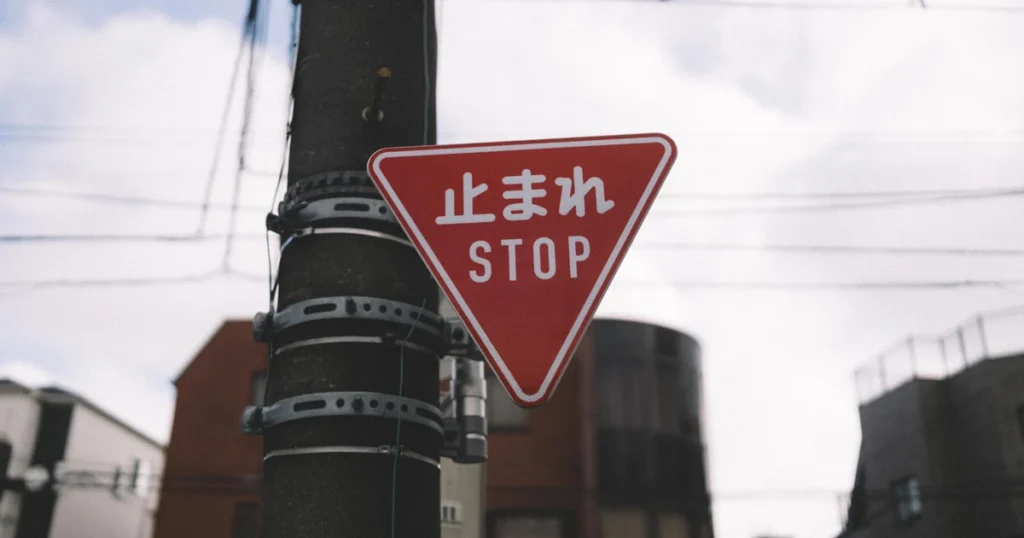
Stop Signs: Look for 止まれ
Japanese stop signs require a complete stop.
You may see the Japanese word:
止まれ (TOMARE)
At a stop sign, stop completely at the appropriate stop line or location and check that it is safe before proceeding.
A rolling stop is not sufficient.
Becoming familiar with common Japanese road signs before your trip can make rural driving considerably easier.
Railway Crossings
Railway crossings are another important rule to remember when driving in Japan.
Drivers generally must stop before a railway crossing and check that it is safe before proceeding.
Where passage across the railway crossing is controlled by traffic signals, follow the signals.
Never enter a railway crossing unless there is enough space on the other side for your entire vehicle.
This is particularly important in smaller towns and rural areas, where railway crossings can be common.
Speed Limits in Japan
If you are accustomed to driving in Germany, Japanese roads can feel slow.
Speed limits on ordinary Japanese roads are often considerably lower than German drivers may expect.
Important Change from September 2026
Since September 1, 2026, the statutory speed limit on ordinary roads without a center line, traffic lanes, or physical separation between opposing traffic has generally been reduced from 60 km/h to 30 km/h.
Where a speed limit is specified by road signs or road markings, that posted limit applies instead.
This means that a road without a center line does not automatically have a 30 km/h speed limit in every situation.
You may commonly encounter posted limits such as:
- 30 km/h
- 40 km/h
- 50 km/h
- 60 km/h
Always follow posted speed-limit signs and road markings, and pay particular attention when entering smaller local roads.
The Japan National Police Agency explains the September 2026 statutory speed-limit change here.
Do not assume that a rural road has a high speed limit simply because it appears wide or empty.
For independent road-trip travelers, this is particularly important because many scenic routes pass through small villages and residential areas.
Driving on Japan’s Mountain Roads
Some of Japan’s most beautiful destinations are reached by narrow mountain roads.
These roads may include:
- Blind corners
- Steep gradients
- Narrow sections where two vehicles cannot easily pass
- Roads without a center line
- Fallen leaves or debris
- Snow and ice in winter
- Wildlife
- Limited mobile-phone reception
Do not assume that a road is easy to drive simply because your navigation system recommends it.
If a route looks unusually narrow or difficult, consider checking the road conditions or choosing a larger alternative road.
Expressways, Toll Roads and ETC
Japan has an extensive network of toll expressways.
Many rental cars are equipped with an ETC (Electronic Toll Collection) device, but an ETC device and an ETC card are not necessarily the same thing.
Depending on the rental company, you may be able to rent an ETC card when collecting your vehicle.
Ask your rental-car company about:
- ETC card availability
- ETC card rental fees
- Toll payment procedures
- Available expressway passes
- How toll charges are settled when the vehicle is returned
If you plan to cover long distances, using Japan’s expressways can save a significant amount of travel time.
Fuel Stations in Rural Japan
Fuel stations can become less frequent as you travel deeper into rural and mountainous areas.
Some small stations also have limited opening hours.
When traveling far from major cities, avoid waiting until your fuel tank is almost empty.
If you have an opportunity to refuel before heading deep into the mountains, it is often a good idea to use it.
Winter Driving
If you are traveling through mountainous regions during winter, snow and ice can significantly change driving conditions.
Depending on the destination and weather conditions, winter tires or other equipment may be necessary.
When renting a car during winter, check:
- Whether winter tires are included
- Whether they cost extra
- Current weather conditions
- Road closures
- Mountain-pass conditions
Do not underestimate Japanese mountain roads simply because there is little or no snow in a nearby city.
Explore Japan Beyond the Golden Route
Japan’s trains are excellent, but some of the country’s most memorable places are difficult to reach without a car.
Driving gives you access to quiet villages, mountain roads, coastal viewpoints, local restaurants, hot springs, small towns, and landscapes that many international visitors never see.
For German travelers, the most important thing to remember is:
German driver’s license + authorized Japanese translation
A German-issued International Driving Permit is not a substitute for the required Japanese translation.
Prepare the correct documents, check your rental company’s requirements, familiarize yourself with Japanese road rules, and take your time getting used to left-hand traffic.
Then leave the crowded tourist routes behind and discover a different side of Japan.
Stop being a passenger. Take the scenic route and start your own Japanese road trip.
Official Resources
Before traveling, check the latest information from these official or authoritative sources:
- Japan National Police Agency (NPA) — Official information about Japanese traffic laws and foreign driver’s licenses.
- Japan Automobile Federation (JAF) — Information about driving in Japan with foreign licenses and Japanese translations.
- ADAC – Driving in Japan — Information specifically for German travelers driving in Japan.
- German Federal Foreign Office – Japan Travel Information — Official German government travel and safety information for Japan.
Always check the latest information before traveling, as laws, regulations, and administrative procedures can change.